IJPC

IJPC NEWS NOTES
Updated 4-2026
2026
Image of the Black Journalist in Popular Culture, exploring the Representation of Black Journalists in Film, TV & Literature, The IJPC Journal, Volumes 11 & 12, Fall, 2023 to Spring 2026. There is virtually no research when it comes to the image of the Black journalist in popular culture. In a special Image of the Journalist in Popular Culture (IJPC) Journal section – The Image of the Black Journalist in Popular Culture – we offer the first attempt to analyze what that image is in film, television and novels through academic and professional perspectives. The Image of the Journalist in Popular Culture (IJPC) is a project of the Norman Lear Center, USC Annenberg.
2025
2024
“What Broadway Gets Right and Wrong About Journalism: A culture writer takes stock of recent stage productions that depict newsrooms and reporters by Sarah Bahr, New York Times, December 20, 2024
UPDATED: 200 Journalism Movies ranked by Quill Magazine by the Society of Professional Journalist, August 30, 2024, by Lou Harry, Midwest Film Journal writers. Note: The popularity of this story prompted us to treat it as a dynamic document, adding more reviews as appropriate movies are released or discovered. So what started as “110 Journalism Movies, Ranked” has morphed into “200 Journalism Movies Ranked.” Hollywood helps define just about everything in America. And journalism is no exception. From “Citizen Kane” to “The Post” and from “Libeled Lady” to “All the President’s Men,” reporters have clashed with editors, danced on both sides of the ethical line, and otherwise populated hits and duds on the silver screen. They’ve been heroic, dangerous, and sometimes very funny. In celebration of the 110th anniversary of SPJ, Quill Editor Lou Harry teamed up with the critics from MidwestFilmJournal.com to watch, review and rank 110 journalism-related films. As noted above, we have been expanding the list ever since.
With film catalog and survey, Argentine journalists reflect on cinematic portrayals of the press, journalists, by Andre Duchiade, LatAm Journalism Review by the Knight Center, July 2024. 8 Latin American films about journalism or journalists, by Andre Duchiade, LatAm Journalism Review by the Knight Center, July 2024
International Survey of the Best Films Featuring Journalists. More than 463 participants from 20 countries voted on the best international films on journalists in a survey created by Federico Poore (periodistasenelcine.com) of the Spanish-based Journalists in Cinema, June 2024. The results include more than 200 films headed by Citizen Kane, All the President's Men and Spotlight. American films are joined by films from Brazil, Argentina, France, Spain, Italy, Japan and South Korea. the site is in SPanish and the link is https://periodistasenelcine.com/top-150/
What ‘Civil War’ gets right and wrong about photojournalism, according to a Pulitzer Prize winner by Greg Braxon and Carolyn Cole, April 16, 2024, the Los Angeles Times. After favorable reviews and a strong opening weekend at the box office, Alex Garland’s provocative “Civil War” is already poised to become one of the most talked- about movies of the year. The filmmaker’s graphic, often terrifying depiction of a war- torn America and a government in crisis has sparked plenty of debate among audiences and critics. And while the story’s “what-if” premise is pure fiction, “Civil War” is nonetheless flavored by a gritty realism central to its power.
From Scoop to Civil War: why is it so hard to portray journalism on screen? By Adrian Horton, Culture, The Guardian, April 14, 2024. The character of the journalist continues to be a trusty mainstay on both the big and small screen, but noble intentions aren’t enough to overcome cliche.
2023
The 21 Best Journalism Movies by Robert English. Entertainment Weekly, November 26, 2023. EW takes a look at some of the best journalism-centric films of all time, spanning classics like “Network” to modern movies such as “The French Connection.” Sometimes the story behind a story can be just as compelling as the actual narrative itself. Cinema's rich history of films chronicling the real and fictionalized accounts of journalists chasing the stories they believe deserve to be told have continued to entertain us for years — investigating imbalances in power, newsrooms generating fraught relationships, and cynical writers learning to look at the world in a new way from the idealization of their subject. Through it all, tales of journalism are ripe for dramatic tension and complex characters.
Why Are Journalists Always the Villain in Hallmark Christmas Movies? by Charlotte Colombo, January 2023, The Digital Fix. In cosy Hallmark Christmas movies and rom-coms, journalists or the journalism industry in and of itself is always portrayed as villainous. "I’m not saying that being a journalist should be a protected characteristic, but you can’t deny that when it comes to movies and TV series, portrayals of writers can often be less than... realistic."
Actor Kate Hudson, speaking on How to Lose a Guy in 10 Days character's impact on the Today Show said "Now there's a new generation of journalists who would say, like 'Wow, Andie Anderson made me want to be a journalist,' and I'm like, 'What! I never would have expected that." Printed in Chatter, People magazine, January 2, 2023.
2022
Editors Laura Castañeda of the University of Southern California and Richard Ness of Western Illnois University announced in November, 2022 that the 11th edition of the IJPC Journal, a special edition of The Image of the Journalist in Popular Culture Journal (The IJPC Journal) has been published featuring the first comprehensive study of the image of the sports journalist in popular culture including film, television and fiction. It features contributions from some of the world’s foremost scholars on sports media and on journalism’s image in popular culture. "Sports have long been an important window into our society, with popular culture regularly featuring the sports journalist as a prominent character. Sports reporters and writers in movies, novels, television, and other popular media have not been much different from their “straight news” counterparts, although their venue has made them unique,” write the editors in an introduction to Volume 10 of The IJPC Journal. “There have been syndicated sports columnists who do anything to get an exclusive, including using blackmail and payoffs. But the majority of sportswriter characters simply have gone out and done their jobs. Some have been heroic in ferreting out corruption in sports, risking public animosity. Most often they have been used as realistic dressing for biographies of sports personalities.”
Dan Durbin, Annenberg professor of communication and director of the Institute of Sports, Media and Society at the University of Southern California, identifies the most common ways in which films have depicted sports journalists, including sportswriters serving as “Greek chorus” characters and real-life sports journalists playing themselves on screen.
Ben Carrington, widely regarded as one of the world’s leading authorities on the sociology of race, politics and popular culture, and an associate professor at USC Annenberg, examines the image of the Black sports journalist and how Black sports journalists have been ignored or forgotten in real life as well as in popular culture.
Donna Halper, associate professor at Leslie University in Cambridge, MA, draws on her scholarly expertise in gender, sports, and media to analyze how popular culture has depicted the female sports journalist.
Alan Tomlinson, Emeritus Professor of Leisure Studies at the University of Brighton, UK, who for many years has researched the social history and sociology of sports, leisure, and popular culture, focuses on the image of the sports journalist in novels.
Chad Painter, assistant professor of Communication at University of Dayton studies the portrayal of sports journalists in such television series as "Sports Night," "The Odd Couple," and "Everybody Loves Raymond."
Julianna Kirschner, lecturer in the School of Communication, looks at the television series "Ted Lasso" and its sportswriter character Trent Crimm, who over the show’s first two seasons has evolved from an adversarial character into a more sympathetic one.
Also included are Brock Adams of Weber State University (an analysis of the film Blue Chips) and James Cartee is a PhD. student in Communication at The University of Tennessee-Knoxville (an analysis of the movie, Iron Will). Jeff Fellenzer, an associate professor of professional practices at USC’s Annenberg School for Communication and Journalism with more than three decades of experience in sports media, interviews Ron Shelton, the writer-director of such classic sports films as "Bull Durham" on how he believes the movies have portrayed sportswriters. The IJPC Journal is accepting manuscripts on any aspect of the image of the journalist or public relations practitioner. Please e-mail Joe Saltzman, professor of communications and journalism and director of the Image of the Journalist in Popular Culture for more information at .(JavaScript must be enabled to view this email address)
AEJMC History Newsletter Cleo Magazine, March 31, 2022: IJPC Director Joe Saltzman, professor of journalism and communications at the Annenberg School for Communications and Journalism, University of Southern California, published “A 21st-Century Method of Teaching Media Ethics” in Media Ethics, The Magazine Serving Mass Communication Ethics, Fall 2021, Vol. 33, No. 1. In the article, he argues that our practices of teaching media ethics must change with the times. He explains how he uses film in new ways to teach journalism ethics. Saltzman also just published “The 20th-Century Image of the Journalist in Hallmark Films, 2000-2020,” in the IJPC Journal, a study of 360 films showing that there are more positive Black, Asian-American and female journalists in Hallmark films contradicting many of the stereotypes its conservative audience has of the news media.
2021
What do CIA Analysts and Investigative Journalists Have in Common? by Karen Cleveland, CrimeReads, August 27, 2021. Both rely on covert sources. Both piece together puzzles. And both can be risky -- and rewarding.
Breaking News: Books with Reporters as Main Characters, by Hank Phillippi Ryan, July 29, 2021, Booktrib. Having a journalist as the main character is good news and bad news. The good news is that it solves one of the trickiest problems in crime fiction writing: if your character is not in law enforcement of some kind (or at least a private detective) and they come across some sort of nefarious activity, say, a murder … why don’t they just call the police? If your character is a reporter, there’s a perfectly good reason. Or, at least, good enough. There are few things as devoted as a good reporter on the trail of the story. And for an author, that’s a good thing. The bad news is that in the search for a ”relatable “or ”likable” character — if that’s your goal — a journalist may not be tops on everyone’s likability list.
The 25 greatest movies about journalism, by Jeremy Smith Yardbarker, June 10, 2021. No one enters the field of journalism expecting to make a fortune. Like many artistic endeavors, it's a calling — and the craft of reporting is absolutely an art. Actors have to learn how to listen, directors have to understand perspective and musicians have to nail down a hook. Reporters have to excel in all of these areas. And so on the 20th anniversary of perhaps the greatest film about journalism ever made, Michael Mann's "The Insider," let's take a stroll through the past and celebrate the best films about an underappreciated yet vital profession.
Hollywood's Diversity Problem by Mia Anzalone, April 6, 2021. Hollywood’s diversity problem is not only Hollywood’s problem –– it is everyone’s problem. Film and television visualize our society as what it should be. If fictional stories and creative worlds are reluctant to include people from all walks of life, how can we expect the world we live in to change?
Spotight & 9 Other Best Movies about Investigative Journalism Ranked by Rotton Tomatoes, by Brenan Mott, Screenrant, March 10, 2021. Investigative jouranlism seems like a dying art, but it makes for good drama in movies like Spotlight, The Paper, The Parallax View and more.
2020
The best journalism movies to watch this Christmas: From Spotlight to The Great Muppet Caper, by Charlotte Tobitt, Press-Gazette: The Future of Media UK., December 23, 2020. Christmas 2020 may have put a spanner in many of our usual festive plans, but there is one traditional thing you can all still do: sit on the sofa and watch endless movies for a week. But they don't all have to be saccharine fests of snow, carols and kissing under the mistletoe. If you're lucky enough not to be in the newsroom between Christmas and New Year, it can be the perfect time to rewatch old favouritges and finally catch up with classics that have so far passed you by. Even if you welcome a break from the (virtual) newsdeak, you might miss it -- so why not kick back without ultimate selection of journalist-centric movies,
Christmas Movies about Bloggers, ranked by Realism, by Carrie Wittner, Vulture Lists, December 18, 2020. Since I am a blogger, who blogs, and Vulture is a blog, naturally I decided to watch every single Christmas movie in the Lifetime/Hallmark/Netflix landscape that is about a blogger, journalist, or writer and rank them according to how realistic the blogging, journalism or writing is. On this journey, I discovered that there are two plots for female protagonists who write in a Christmas film: cynical journalist reluctantly travels to Christmas town, falls in love; or: optimistic reporter wants to write about the Christmas spirit, and falls in love along the way.
Journalism Movies: 61 Must see movies for journalists by Ernst-Jan Pfauth, Journalism, .June 20, 2020
Best Hollywood films about journalism in recent times, by Devesh Sharma, Filmfare.com, April 17, 2020. Newspapers and newspapermen are said to be the conscience keepers of society. Ideally, they should be free of the diktat of the advertisers and the government and publish the closest possible version of the truth. When they go ahead and do it, that’s when real headlines happen. Journalistic work isn’t glamorous at all but painstakingly boring. It involves following leads at odd hours, checking the facts with a telescope and connecting the dots patiently till you get the whole sordid picture. Presenting some of the Best Journalism Hollywood Films based on newsrooms and newshounds to have come out of Hollywood in recent times.
"The Best Reporters in Comic Book History," Ranking the very best journalists on the superhero beat, by James Queally, March 11, 2020, Crimereads. Whether it's Gotham City, Metropolis or Marvel's version of New York City, it's hard for the public to know what's really going on when the most important news on any given day often involves masked figures throwing down in secret headquarters...so let's take a look at some of the best reporting in comic book history.
"It's a Bird, It's a Plane, It's -- a Journalist? Joe Saltzman on the Image of the Journalist in Pop Culture," by Alex Eichenstein, James R. Soles Fellow, published March 6, 2020, Center for Public Integrity.
"Journalists on film -- the Quest for Truth." by Rich Egger, National Public Radio, February 13, 2020. An interview with Richard Ness, author of Encyclopedia of Journalists on Film. Ness reviewed 4,500 films before narrowing his focus to 500 films including entries about the basics such as Citizen Kane, All the President's Men and Spotlight. But he said the book delves deeper than that, "I also tried to put in some films that maybe people wouldn't necessarily think of immediately but either represent trends in journalism films or presented maybe things from another culture or another country that showed the universality of how journalism is treated."
Ten of the best crime novels about journalists, by Kate Vane, Crime Fiction Lover, February, 2020. Journalists make great protagonists in crime fiction. They have the skills and the resources to investigate, but their motives are often quite different from the police. They can range from the determination to be first with a story, regardless of the consequences, to a burning desire to right an injustice. They aren’t bound by the same rules as the police and often people will speak to them who have their own reasons for avoiding contact with officialdom. Sometimes they work with the police, sometimes they are in competition, often there’s an uneasy trade-off between the two.
2019
Why the tired trope of the sexualized female journalist persists in the movies such as 'Richard Jewell' by Deanne Pan, the Boston Globe, December 12, 2019. Hollywood loves female journalists as long as they are sleeping with someone. Matthew Ehrlich, a professor emeritus at the University of Illiionios at Urbana-Champaign, is quoted: "Female journalists have been depicted from the very beginning in popular culture -- as being very aggressive, being very talented, being as good if not than their male counterparts. Quite frequently you would see them giving up their jobs willingly for romance in movies." He adds, The trope reflects a broader sexist stereotype of women in the professional world -- namely, that for a woman to achieve any kind of power or prestige, she must rely on something other htan her own hard work and talent.
An Exhaustive Ranking of Movie Journalists, by Kate Knibbs, theringer.com/movies, November, 2019. From "His Girl Friday" to "A Beautiful Day in the Neighborhood." which movie muckrakers get their stories, break the most news and, most importantly, avoid sleeping with their subjects?
From the Newsroom to the Television Screen: The Blurred Line Between News and Entertainment, by Randy Minkoff, September 26, 2019, Center for Digital Ethics & Policy.
Find Out how Jimmy Olsen won his Pulitzer Prize in this exclusive preview, by Oliver Sava, August 20, 2019, AVClub: Pop Culture Obnsessives Writing for the Pop Culture Obsessed. Superman's pal Jimmy wins journalism's highest award.
Torchy Blane: The most famous fictional journalist you've never heard of, Michael Castegnera, July 2, 1029, Radio Televison Digital News Association (Visibility, Advocacy, Training, Resources, Networking and Awards for Broadcast and Digital Journalists. Move over, Murphy Brown. Forget about Sex and the City's Carrie Bradshaw, Gilmore Girl's Corey Gilmore. Meet the most famous fictional journalist you've never heard of. Her real name was Glenda Farrell and she starred in seven movies "beautiful, headline-hunting, wisecracking female reporter' Torchy Blane.
110 Journalism Movies, Ranked, by Lou Harry, Quill Magazine, the magazine by the Society of Professional Journalists, June 3, 2019. Hollywood helps define just about everything in America. And journalism is no exception. From “Citizen Kane” to “The Post” and from “Libeled Lady” to “All the President’s Men,” reporters have clashed with editors, danced on both sides of the ethical line, and otherwise populated hits and duds on the silver screen.
Is it a bird? Is it a plane? No, it's a journalism ethics quandary! byJames Grebey, Columbia Journalism Review, February 22, 2019. The most famous journalist of all time is also the most famous superhero. For the past three-quarters of a century, with a few exceptions, his alter-ego Clark Kent, has been working as a reporter for the Daily Planet. In a new DC Comic series, he and Lois Lane, his Pulitzer Prize-winning wife, meet a fiendish new foe -- a complicated question of journalism ethics.
There are a lot of great journalism movies. Here are our top 25 by Tom Jones, Poynter.org. Most journalism movies, even the ones that aren't exactly like the day-to-day lives of flesh-and-blood journalists, are still pretty entertaining. Many perfectly capture the journalistic experience. That's why coming up with a list of 25 best ever movies about journalism was not easy. Yet, we're confident in our selections. So grab your popcorn and take in our 25 Greatest Movies About Journalism.
2018
The Scoop: Journalism in Movies -- a 13-minute documentary on the image of the journalist in films.
The Lazy Trope of the Unethical Female Journalist by Sophie Gilbert, The Atlantic, August 20, 2018. With Camille Preaker, Zoe Barnes, and Rory Gilmore, Hollywood's depictiosn of women reporters have never been further from reality. For some reason, and despite all assurances from reporters to the contrary, Hollywood is stuck on the idea that female journalists are having sexual relationships with their bosses, their sources, or both. The trope of the unethical female reporter has persisted for several decades, throughout fiction, film and television.
The Journalist Detective: 11 Great Crime Books Featuring Investigative Reporters, by J.G. Hetherton, Crime Reads, June 21, 2018.
Newspaper Movie produced by Late Night with Seth Meyers. A film about about an intrepid group of reporters that satirizes every newspaper movie ever made including All the President's Men, The Post and Spotlight.
A World of Cop Reporters by Sebastian Rotella, March 16, 2018, CrimeReads. From Chicago to Tijuana, Snapshots of Crime Scribe Culture.
News on film: How Spielberg's The Post continues Hollywood's tradition of making anti-heroes out of journalists. Accepting her Cecille B. DeMille award at the Golden Globes last year, Meryl Streep extolled the virtues of the press -- and was echoed by this year's winner Oprah Winfrey. Now as Streep stars in the latest film about newspapers, David Barnett shouts 'read all about," by David Barneett, The Independent, United Kingdom, January 13, 2018.
The 10 Best Journalism Movies (Including Steve Spielberg's 'The Post'), Ranked, by Brian Truitt, USA Today, January 11, 2018.
2017
Image of theJournalists in the movies present the dogged fight for truth -- as in "The Post" -- as well as the scoundrels, by Lewis Beale, Los Angeles Times, Envelope, December 28, 2017. "Journalism isn't exactly held in high esteem these days. Yet despite a recent USA Today poll that foound nearly two-thirs of Americans disapprove of the mainstream media, that hasn't deterred Hollywood's fascination with the Fourth Estate, particularly its print component."
White knights in film noir: How journalists in the movies affect the public's trust, by Michelle Cuthbert, The Signal, November 20, 2017. North Americans have a skeptical view of the press. According to a 2016 study by the Reuters Institute for the Study of Journalism, only 47 per cent of Canadians and 27 per cent of Americans agree that “you can trust journalists most of the time”. Most people never personally interact with a journalist. Joe Saltzman, a professor of journalism at the University of Southern California-Annenberg, and founding editor of The Image of Journalists in Popular Culture journal and database, says people get ideas about journalists from popular culture.
Image of the Public Relations Practitioner in Popular Culture. White House Comunications Team Impacts the perception of the public relations profession, USC Annenberg survey reveals. Over 80 percent of PR professionals polled believe WH spokespeople “constantly change their views” and “distort the truth." June 20, 2017, a survey of public relations professionals conducted by the USC Center for Public Relations at the Annenberg School for Communication and Journalism. Link: http://annenberg.usc.edu/news/faculty-research/white-house-communications-team-impacts-perception-public-relations-profession.
2016
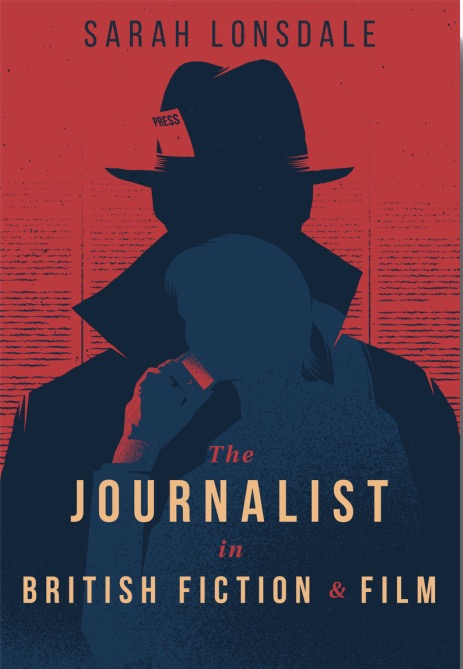
The Journalist in British Fiction and Film: Guarding the Guardians from 1900 to the Present
by Sarah Lonsdale will be published in July, 2016.
Dr Sarah Lonsdale has worked as a journalist for 25 years, and joined academia in 2006.
She lectures in journalism at City University in London and completed her PhD,'The Representation of Journalists and the Newspaper Press in British Fiction 1900 - 1939',
upon which her book is partly based, in 2013.
She contributes to the Sunday Times and Telegraph newspapers.
Lonsdale offers a preview of her book in this essay
written exclusively for the IJPC entitled
The Journalist in British Fiction.
Whoa: This "Zootopia" character looks different around the world, by Lilian Minn, March 7, 2016. Co-Anchor Peter Moosebridge (Peter Mansbridge - Voice), a moose co-anchor of the ZTV News, is used in the standard version of the film released in the United States, France, Canada, Russia and Mexico. In other countries the anchor is a different animal voiced by a different person. Koala Newscaster (David Campbell - Voice) in the Australian version, which was also distributed in New Zealand. A jaguar (Ricardo Boechat) in the Brazilian version. Tanuki used in the Japanese version. Giant Panda in the Chinese Version. Corgi in the British version.
"I'm in the 'Spotlight,' but it's not really about me. It's about the power of journalism," by Martin Baron, The Washington Post, February 24, and "'Spotlight' joins 'All the President's Men' in the pantheon of great journalism movies," by Ann Hornaday, The Washington Post, November 12, 2015.
Q&A: The Image of the Journalist in Popular Culture. In light of Spotlight’s six Oscar nominations – and the winners being announced at the Academy Awards ceremony on Sunday, Feb. 28 – we talked to Joe Saltzman, co-author (with Matthew C. Ehrlich) of the new book Heroes and Scoundrels: The Image of the Journalist in Popular Culture (University of Illinois Press).
2015
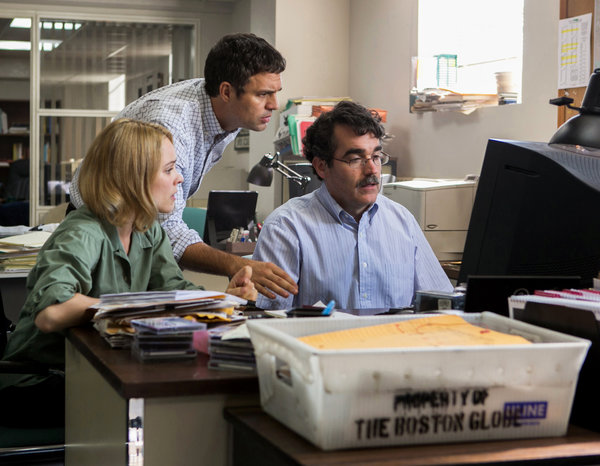
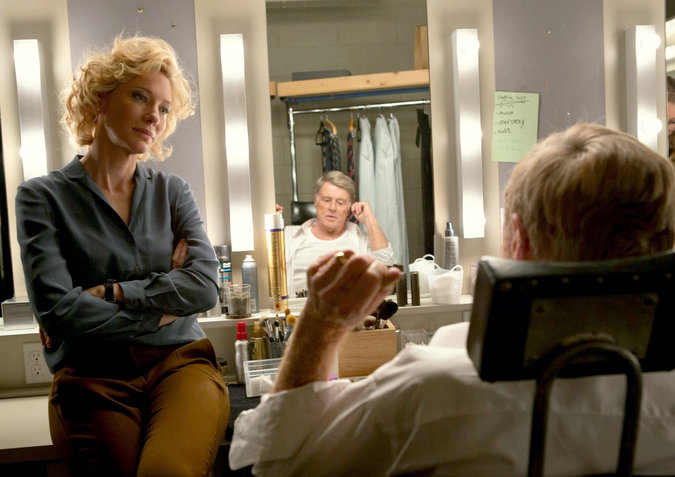
"When Journalism Catches Hollywood’s Eye" by Joe Nocera, New York Times, Dec. 31, 2015. It is not every year that Hollywood produces two movies about journalism that are Oscar contenders, but 2015 appears to have been that year. First came “Truth” in October. Based on the memoir of a former “60 Minutes” producer, Mary Mapes, it purports to tell the story of her gutsy 2004 investigation into George W. Bush’s service in the National Guard when he was a young man.
"Spotlight: Why It Works and How it Matters," by Bill Mitchell, November 6, 2015, Poynter.org Mediawire. Mitchell reviews the new film "Spotlight" by pointing out that the film "reveals just enough about the journalists to make them sympathetic, flawed and accessible. Their interactions with abuse survivors show them to be compassionate human beings as well as hard-charging investigators." He adds, "And unlike Watergate, a once-in-a-lifetime, only-in-Washington sort of blockbuster, clergy sexual abuse is a story that continues to unfold in hundreds of communities and newsrooms around the world. The film concludes, in fact, with a screen-after-screen list of cities and towns where the abuse drama erupted beyond Boston." To read the entire review, go to http://www.poynter.org/news/mediawire/383478/spotlight-why-it-works-and-how-it-matters/
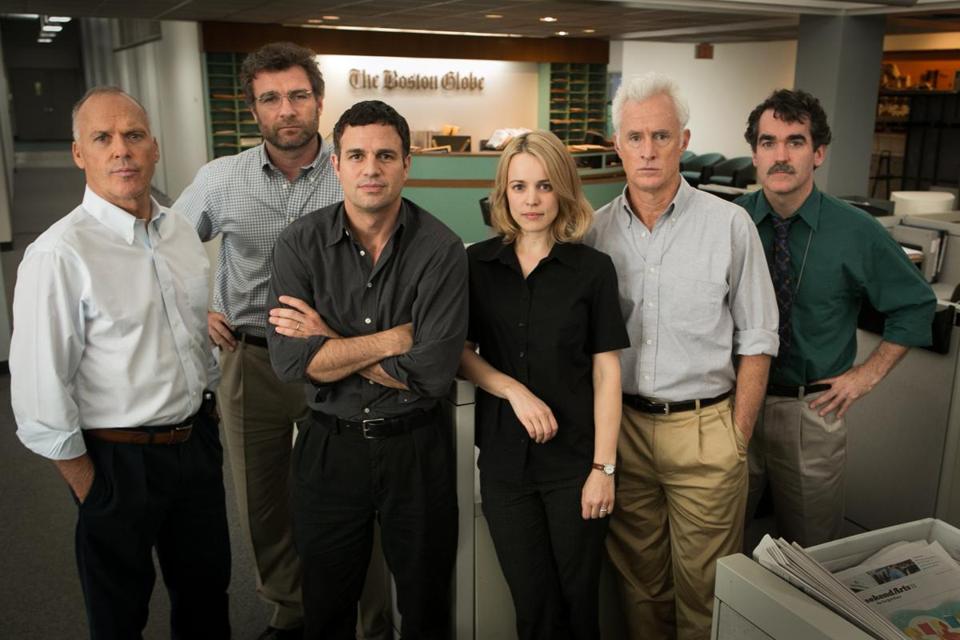
"Newspapers may struggle, but newspaper movies are forever," by Mick LaSalle, movie critic for the San Francisco Chronicle, Oct. 26-27, 2015.
"Don't Believe Hollywood's sexual fantasies about female journalists," by Hadley Freeman, http://www.theguardian.com, July 29, 2015. "In the movies, we jump into bed weith practically every interviewee. Strange how men don't get the same treatment."
"How PR People Are Portrayed in the Media," by Tom Watson, professor at Bournemouth University, PRmoment.com, April 27, 2015.
IJPC Director Joe Saltzman talks about Heroes and Scoundrels: The Image of the Journalist in Popular Culture, written by Saltzman and co-author Matthew C. Ehrlich.
"Memo to Hollywood: Female Journalists Don't Sleep With Their Subjects," by Elisabeth Donnelly in Flavorwire, Jan. 5, 2015. "More often than not, when there's a film featuring a female journalist, her sexuality, and what she does with it is part of the plot. All too often she's just a cipher saddled with a 'smart' job, sometimes glasses, and she's required to sleep with the lead character." Includes films such as Top Five, Crazy Heart, Nashville, House of Cards, Three Kings, How to Lose a Guy in 10 Days, Adaptation, His Girl Friday, Broadcast News and Nightcrawler.
2014
"The Interview Reinforces a Negative View of US Journalists," by Peter Klein, Columbia Journalism Review, December 30, 2014. "The history of kidnapped journalists is filled with tragic tales of reporters being mistaken for spies. The Interview is a dangerous movie. Why make a big deal of a movie that's clearly fiction? Because it plays right into the farcical notions of the world's tyrannical leaders -- that journalists are secretly working for the CIA, an assumption which carries tragic consequences.
Joe Saltzman presents a summary of the study of “The Image of the Washington Journalist in Movies and television, 1932 to 2013” at the National Press Club in Washington D.C. on Thursday November 13, 2014 at 6:30 p.m. The presentation will include a 15-minute video excerpted from the 8-hour and 20-minute video compilation.
“Who are your favorite TV show journalists?" by Kristen Hare, Sept. 19, 2014, Poynter. Hare wants to know what your favorite journalists from sitcoms are and choose three: Paris geller from “The Gilmore Girls,” Betty Suarez from “Ugly Betty,” and Les Nessman from “WKRP in Cincinnati.”
"Hollywood Thinks Journalists Are Sexy Again," by Lloyd Grove, Sept. 17, 2014. Beaststyle. Viewers' hunger for deadlines, scoops, hungry reporters and ruthless editors appears insatiable.
The Press, Obama and War Against ISIS, 9-11-2014. 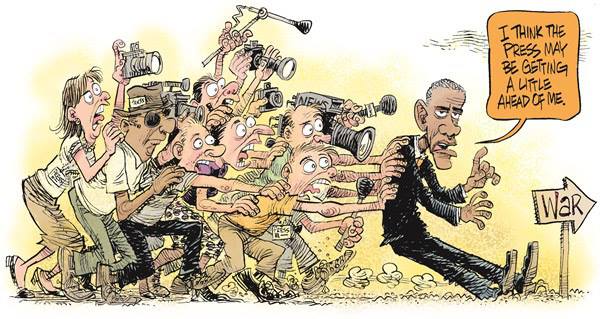
Why Do We Treat PR Like a Pink Ghetto? by Ann Friedman, July 18, 2014, The Cut, NYMAG.COM.http://nymag.com/thecut/2014/07/why-do-we-treat-pr-like-a-pink-ghetto.html
Like any journalist, Friedman writes, "I'm on the receiving end of a fair number of PR emails. Frankly, sometimes they suck; but I can admit that I've gotten some good ideas from publicists too -- there's a range from annoying to on-point. One thing is pretty consistent, though: PR emails almost always come from women. Friedman adds, "Even when women are doing promotional work at higher levels, they still struggle for respect." While there are many men in PR -- including 80 percent of upper management -- it's women, often young women, who are likely to be doing the grunt work of sending emails and writing tweets and cold-calling contacts.
Peter Parker and Clark Kent: Very Unethical Journalists by Daniel D. Snyder, May 1, 2014. Both Spider-Man and Superman, formative and iconic characters in their genre, pay the bills and disguise their identities by working as journalists. However, spunky photojournalists/mild-mannered reporters also have ethical obligations that should clash with supernatural crime fighting. The media is, in theory at least, supposed to be honest. Putting on a costume, coming up with a fake name, and lying to everyone about what you really do are the opposite of that.
“‘House of Cards’ journalists portrayed as odd but at least they’re not sociopaths,” by Roy
Peter Clark, Feb. 24, 2014, Poynter. Perhaps ebcause the shallow water is so polluted, journalists in "House of Cards" don't look so bad. Individually, each is a mess.
Why are all the House of Cards journalists so bad at journalism? Zoe and the gang can't report, lack ethics and have the common sense of a hacker's guinea pig. Somebody should fire them, by James Bell, theguardian.com, Friday, Feb. 21, 2014.
Jurnos in film and TV, Australian Broadcasting Company, January 16, 2014. The loud and gruff editor who nonetheless loves the news business, the pack of nameless reporters who hound the innocent in pursuit of their 'story', the hardworking investigative reporter who goes after the most powerful interests in her city. Do the many books and movies that feature journalists and journalism get at the heart of the profession or do they wheel out tired stereotypes? And why does it matter? According to Joe Salzman, who has gathered arguably the world's largest database of popular culture representations of journalism, the public's views of journalists is strongly shaped by how the entertainment media represent the profession. http://www.abc.net.au/radionational/programs/mediareport/4-july-2013/4765074
Medias, Le miroir aux journalistes, by Stephane Baillargeon, Le Devoir, 13 janvier 2014. Article from France on the Image of the Journalist in Popular Culture.
2013
"The Newsroom" has its critics, fans among journalists, by Meredith Blake, August 23, 2012, Los Angeles Times Television. Many members of the news media who watch the HBO series, "The Newsroom" were unhappy with its first season, but Season 2's revamp has won some grudging respect. IJPC Project Director Joe Saltzman is quoted.
The Five Stereotypes of Journalists in Bollywood, a Delhi blog highlighted the work of two London-based Indian journalists, Ruhi Khan (formerly of Hindustan Times, Mumbai Mirror and NDTV) and her husband Danish Khan (formerly of Mid-Day and Mumbai Mirror) who analyzed 33 films over the last 30 years and wrote a paper for the IJPC Journal, From Romeo to Rambo: Popular Portrayals of Journalists in Bollywood Cinema. "Our analysis revealed five popular representations of the journalist that we have classified as romantic companion, glamour chaser, investigative superhero, power magnate and brainless moutpiece."
USC Annenberg's Clark Kent, Lois Lane Expert Reviews Man of Steel, July 10, 2013. With the latest Superman film, Man of Steel, raking in ticket sales, Jeremy Rosenberg decided to check in with USC Annenberg School for Communication and Journalism Professor Joe Saltzman. Saltzman, director of the Image of the Journalist in Popular Culture, a project of the Norman Lear Center, is an expert on all things Clark Kent, Lois Lane, Perry White and Daily Planet-related.
Here's What Would Happen If Clark Kent Tried to Get a Newspaper Job Today, by Jim Romnesko, June 7, 2013, JIMROMENESKO.COM. July 10, 2013
With the latest Superman film, Man of Steel, raking in ticket sales, Jeremy Rosenberg decided to check in with USC Annenberg School for Communication and
Journalism Professor Joe Saltzman. Saltzman, director of the Image of the Journalist in Popular Culture, a project of the Norman Lear Center, is an expert on all
things Clark Kent, Lois Lane, Perry White and Daily Planet-related.
"Obama's Elitism on Full Display" by Bill Boyarsky, Truthdig, May 31, 2013. The image of the press as something scurrilous is deeply rooted in our society. University of Southern California journalism professor Joe Saltzman, who heads USC Annenberg’s Image of the Journalist in Popular Culture program, said in an interview with a faculty colleague, blogger Henry Jenkins, “When your favorite aunt asks you why would anyone go into journalism, a profession filled with arrogant, impolite reporters who invade people’s privacy, make up stories and sensationalize the news, where is she getting her information? She probably doesn’t know any journalists, has never visited a newsroom, and has no idea how reporters work. Yet she has very specific ideas about who journalists are and how they behave. And she learned this by watching journalists in the movies and on television and reading about them in novels.”
From my years in reporting about the rich and powerful, circles Obama now travels in, I have found they feel the same as Saltzman’s mythical favorite aunt. In fact, their attitude may be stronger because of class and educational biases. This doesn’t just apply to Obama. The Ivy League and big corporations and law firms have provided many Cabinet and staff members for other administrations. Having gained privilege and wealth, they don’t understand why an intelligent, talented person would take another course.
As Saltzman said, “Surveys continue to show that most Americans want a free press that is always there to protect them from authority, from Big Business and Big Government, and give them a free flow of diverse information. But those same surveys also show that most Americans harbor a deep suspicion about the media, worrying about their perceived power, their meanness and negativism, their attacks on institutions and people, their intrusiveness and callousness, their arrogance and bias.”
Americans who feel that way might ask why a decent woman or man would go into such a business. Why would journalists try to obtain material that government officials, from the president on down, consider secret? Have they no respect for authority? I think journalists should question authority, right from the beginning, when their first tasks are digging up hidden local police reports and crooked city hall contracts. From there, those who stick with it will go on to try to open up the secrets of the highest levels.
“Hollywood's utter failure to accurately portray female journalists" by Neda Semnani. The Week. "We are not plucky brunettes sporting hipster glasses, ready to tussle with old-school editors and sleep with anyone who gets between us and a scoop." May 18, 2013
“Telling a True-Life Story, Following a 'True-Film' Style by Michael Cieply, The New York Times. In a movie called “True Story” — its tale is true, to a degree — he is playing a disgraced reporter, the real-life Michael Finkel. The film, from Brad Pitt’s Plan B Entertainment, is the latest to explore the foibles of journalism as part of a small but sometimes distinguished cinematic subgenre. April 17-2013.
From Sob Sisters to Girl Bloggers in A Site of Her Own, Women, Tech Journalism, February 5, 2013. "Hildy Johnson chased down stories for a newspaper. Murphy Brown worked out of a cable station. And, as Poynter's Mallary Jean Tenore wrote in this piece, today's fictional, writerly heroines tend to toil away on blogs. Tenore's story reminded me of The Image of the Journalist in Popular Culture, a project by USC Annenberg to document fictional journalists through the ages. The backjbone of the project is a searchable database full of fun tidbits, but it also makes for an interesting study in how technology and evolving gender standards are changing perceptions of female journalists.
How Bloggers Became the New Chick Lit Heroines, by Mallary Jean Tenore, Poynter, February 4, 2013. "The Carrie Bradshaws of the literary world are out of vague. "Sex and the City'"s Bradshaw and other female protagonists in chick lit from the '90s amd early 2000s had glamorous jobs in print journalism. Now, bloggers who work long hours and wear muumuus instead of tutus are the new literary heroines."
Chick Lit Has a New Heroine: The Semi-glamorous Life of the New Media Maven by Molly Fischer, New Republic, January 29, 2013. "Print journalism was once a reliable career for the heroines of so-called chick lit. We had Carrie Bradshaw, who got her start as a columnist in Candace Bushnell's pages, Andrea Sachs, Lauren Weisberg's Vogue serf; and Becky Bloomwood, aka Shopaholic, ironically employed at a personal finance magazine. Jennifer Weiner gave us Cannie Shapiro, fesity entertainment reporter; Jane Green gave us Jemima J., somewhat less feisty, still working at a newspaper. The authors inventing these heroines had often worked as journalists themselves. They knew what they were talking about; they had stories to tell. Print journalism promised excitement (colorful characters, a dash of creativity) but also reassuring stability -- a place where women could clock in for manageable daily adventures then clock out for afterhours drama. But as print journalism has become a decreasingly reliable real-world profession, a new brand of chick lit has emerged. It is set against a somewhat less glamorous backdrop: the blogosphere."
Lights, Camera, Action! The Definitive List of Films for Journalists by George Berridge, Wannabe Hacks, February 1, 2013. As journalists, it can often be difficult to explain to others exactly what we do, how we do it and, crucially, why we do it. It probably doesn’t help that we talk in jargon, shout at Question Time, write in indecipherable shorthand and go on and on about retweets. We’re like sweary enigmas. Nevertheless, it is somewhat fortunate that films about our industry are fairly common and have proved popular with the box office. If you’re failing to explain why you do what you do, perhaps it’d just be easier to gather round some friends, watch a film like All the President’s Men then point at the screen and say “that.” Films about journalism can also do great things for your motivation and inspire you when you’ve had one of those weeks: the one where the stories fall apart, your contact goes to ground or your camera breaks when you’re out filming.
2012
‘Take This Job An Planet!”: Why Clark Kent Quit His Day Job by Glen Weldon, NPR, October 24, 2012. In the pages of Superman #13, Clark Kent quits his once-beloved great metropolitan paper. Disillusioned by his employer’s increasing predilection for glitzy infotainment over hard-hitting news, Clark takes a principled stand and abandons print journalism.
“5 movies that get the newsroom right” by John P. Avlon, CNN Contributor, Saturday June 23, 2012. The senior political columnist for Newsweek offers his nominations for the top five journalism films of all time.
A Minute With...Matthew Ehrlich, author of Journalism in the Movies, University of Illinois at Urbana-Champaign, June 18, 2012. Journalism will be getting dramatic treatment starting on June 24 with the premiere of HBO’s “The Newsroom,” the latest creation of “West Wing” producer/writer Aaron Sorkin. Will viewers like what they see in the portrayal of journalists and the workings of the news media? Journalism professor and former radio reporter Matthew Ehrlich thought that movies about journalism mostly undermined the press. Then he took a critical look to write “Journalism in the Movies.” Ehrlich discussed the new series and the public’s dramatic perceptions of journalism with News Bureau social sciences editor Craig Chamberlain.
"Real Reporters on the Screen? Get Me Rewrite! All the News That’s Fit to Screen: Movies About Journalism," by Dan Barry, New York Times, June 8, 2012. A personal tour of some of the writer's favorite movies featuring journalists.
Andrew Sorkin, whose new series on HBO is called “The Newsroom” told Entertainment Weekly that he wanted to offer a positive image of the broadcast journalist. “Reporters used to be the good guys in popular culture, and I wanted to write them that way.” The 10-episode series is expected to air in 2012 and follows a fictional nightly news broadcast reminiscent of Keith Olbermann's late MSNBC program Countdown. TV Cable News Staff of News Night, the flagship newscast of Atlantis World Media. Anchor Will McAvoy (Jeff Daniels). The new Executive Producer is MacKenzie McHale (Emily Mortimer). Cable News Division President Charles Skinner (Sam Waterston). Leona Lansing (Jane Fonda) is the CEO of cable news network’s parent company. Newsroom Staff: Maggie (Alison Pill), associate producer of "News Night." Sloan (Olivia Munn), a financial analyst with a show on the network. Neal (Dev Patel). Jim Harper (John Gallagher, Jr.), a producer who was offered another job when MacKenzie's previous show was cancelled but turned it down to follow her to News Night. At his new job, he shows feelings for Maggie. Don (Thomas Sadoski), New Night's former executive producer who leaves for the new program on the network.
In the pilot, Will is forced to contend with a new team after his co-anchor lands a new program and takes most of his staff with him. "McHale is a well-respected news producer, but she's like a bull who carries around her own china shop. Her fatal flaw is also her superpower -- she's impervious to cynicism. She's been brought in by the president of the news division Skinner to push McAvoy to his full potential, which is the last thing Will wanted anyone to do." (Sorkin) "Will McAvoy is the anchor of News Night, the flagship newscast of Atlantis World Media. His popularity is unmatched by any cable news anchor not on Fox, but his popularity is due largely to the fact that he clings to the middle of the road and has managed not to bother anybody. His success on the air doesn't translate to happiness off of it, though. He's lonely, miserable and out of hope." (Sorkin). Said to be modeled after Keith Olbermann. "Each episode takes place in the recent past." (Sorkin).all-star cast.
Hollywood Hacks: Journalism in Film Through the Ages, by Edward Randall, XCity for Journalism Alumni of City University London, March 19, 2012.
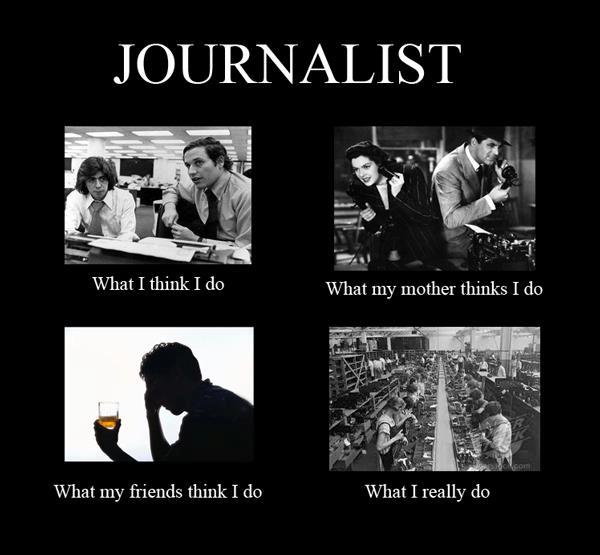
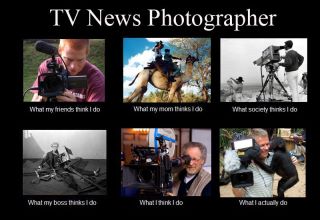
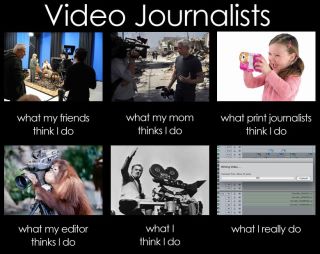
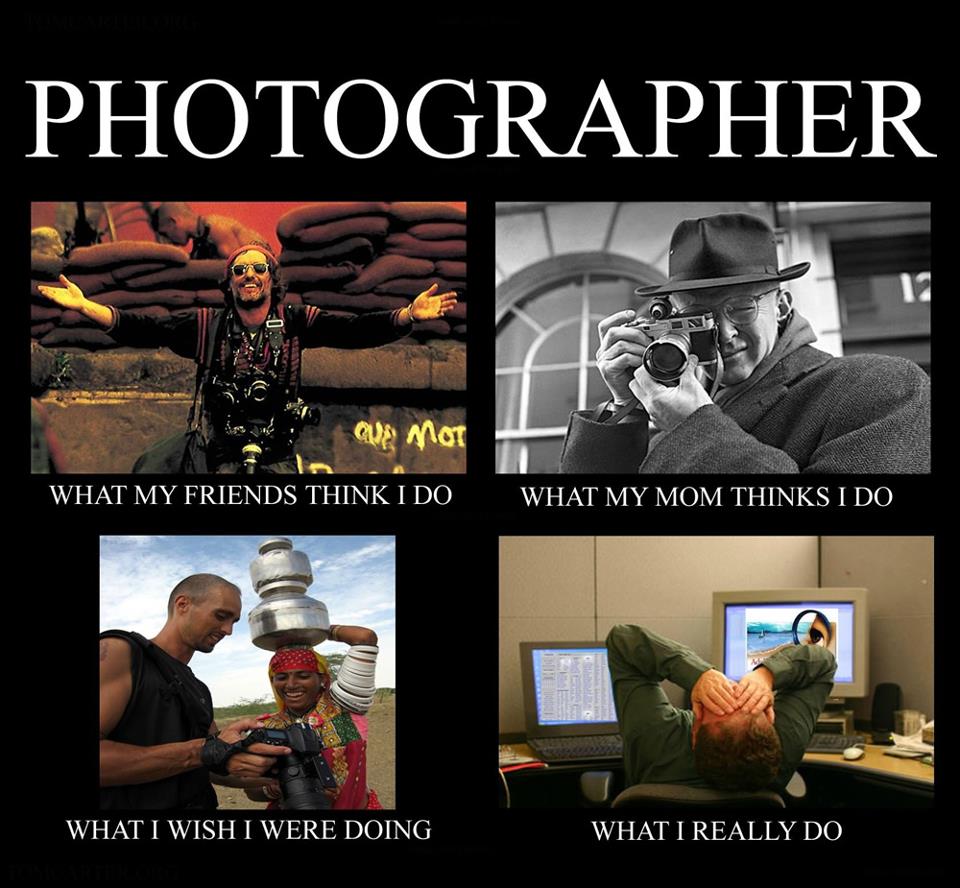
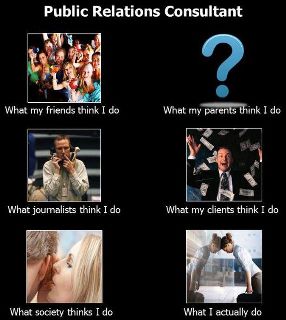
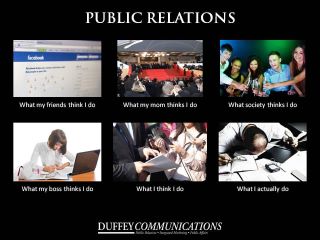
Images of Journalists, TV News Photographer, Video Journalists and Public Relations use popular culture to define themselves with humor. Examples:
The Girl Who Loved Journalists by Eric Alterman, Columbia Journalism Review, Reports, January-February, 2012. For a profession whose entire raison d'etre is communication, American journalists sure have done a lousy job of explaining why the slow-motion disintegration of the business model upon which their livelihoods have depended for tghe past three hundred years might have significant negative consequences for the country. Ironically -- and apparently solmehow below the radar of most journalists in Ameirtca -- the profession was recently blessed with what could have been, and still might be, the most effective propaganda vehicle for the societal significance of journalism I could imagine. His name is Mikael Blomkvist, and the paunchy, forty-year-old, lady-killing, black-coffee-and-bourbon swizzling, cigarette-smoking, crusading feminist, Swedish journalist just happens to be the hero of perhaps the best-selling book series in the world.
Can Journalists Write Novels? by Robert McCrum, The Guardian, October 15, 2012. Some people assume that AWill Self's prodicious output as a journalist means his novels can't be any good. But that's faulty reading.
2011
Plucky, Intrepid Female Reporter for Major Motion Picture by Julie Moos, published Oct. 12, 2011 and Characteristics of the Intrepid Female Reporter by Kay Steiger, published on Oct. 11, 2011 on the Internet. Kay Steiger is tired of movie characters like The New York Times reporter played by Marisa Tomei in the political thriller, "Ides of March." Tomei, who also played reporters in "The Paper" and "War Inc.," said she didn't do much prep work for this film. Nor did the script require her to, according to Steiger.
All the Editors That Are Fit to Spoof, by Kevin Flynn, New York Times. August 10, 2011. If you’re a newspaper editor on stage or screen, you are, as often as not, crusty, loud and easily exasperated. Big things, little things, all kinds of things annoy you. Deadlines. Missed scoops. Staff running amok. A cub reporter who insists on calling you Chief. But perhaps no editor has ever been as unceasingly incensed as J. Jonah Jameson, the bombastic leadeer of The Daily Bugle in the Broadway musical, "Spider-Man: Turn Off the Dark," for whom the irritants have expanded from typos and limp headlines to the many encorachments of time and technology.
Our 10 Favorite Journalists in Pop Culture by Caitlin Peterkin, Paste Magazine.Com, July 30, 2011. We here at Paste want to honor some of our favorite editors and reporters in film, comics, literature and television. Their methods may be a little questionable or over-the-top at times, but we guarantee you that they’re all Pulitzer-worthy compared to the News of the World folks.
Brenda Starr, the world's most famous fictional reporter and role model to generations of aspiring female journalists,will now have her own series of reprint volumes starting with the comic strip's debut on June 30, 1940. Created by Dale Messick, the first woman to create, draw and write a syndicated newspaper strip, Brenda Starr became one of the longest running features in newspaper history ending its syndication in January, 2011. Volume One was issued in June, 2011 at $60 a volume.
From Brenda Starr to Wikileaks to Robot Reporter: Northwestern University Library exhibit asks, “Who is the Journalist?” by Wendy Leopold, April 4, 2011. Using books and rare library materials, artifacts from working journalists and videos of pop culture depictions of reporters, "Who is the Journalist: The Past, Present and Future of News" explores how the nation’s first newspaper publisher, Brenda Starr, Ida B. Wells, Clark Kent, Bob Woodward, Carl Bernstein and others used their power to instruct, inspire and innovate. The exhibit was developed by former Medill School of Journalism Dean and a board member on The IJPC Journal, Loren Ghiglione.
This Just In: Journalists in Popular Science Fiction & Fantasy Are Evil by Ryan Britt in Tor.Com, Feb. 23, 2011. In the various science fictional worlds of comic book superheroes; possessing the profession of a journalist almost guarantees you’re a good person. Between Lois Lane, Clark Kent and Peter Parker it's almost as if working in the media makes one destined for sainthood. But what about journalists depicted in science fictional contexts that are not in the genre of comic books? What about the journalists of the 23rd, 24th, or 80 Billionth Century? When looking at some examples of these SF&F news media characters, they almost always are portrayed as villains.
Lois Lane: Girl Reporter is the book DC didn't want you to read. Lois Lane, Girl Reporter follows the adventures of young Lois Lane. At eleven years old, Lois has discovered her calling: investigative journalism. She sets out to right wrongs and help out her friends. This series explores Lois's character, reveals her surprising early influence on the future Man of Steel, and introduces fun new elements into this enduring character's back story.In each book, Lois will tackle a problem or mystery affecting the members of the community she finds herself in as she travels around the country. The investigations in this series will not be mystical or supernatural (though some characters may suspect such sources), but real world problems that Lois works to set right. Over the course of the planned five-book series, Lois would've made her way to Gotham and encountered a 13-year-old Bruce Wayne, tussled with Lex Luthor and kindled a love for journalism in a young Clark Kent.
Woman who inspired Daily Planet Reporter Lois Lane dies at 93. Joanne Siegel, who as a Cleveland teenager during the Depression hired herself out as a model to an aspiring comic book artist, Joe Shuster, and thus became the first physical incarnation of Lois Lane died on Saturday, Feb. 12, 2011 in Santa Monica. She was 93.
2010
Newspaper Heroes on the Air by Bob Stepno, December 17, 2010. Journalism today needs heroes. For inspiration — or at least food for thought about what might make a journalist “a hero” — this site explores radio’s portrayals of men and women of “the press” back when broadcasting was going from hot “new media” idea to prime-time
Comics Reporter Brenda Starr Leaving the Biz, December 9, 2010.
Tom Rachman on Journalism, Female Characters, and Brad Pitt by Tom Rachman, The Atlantic, August 14, 2010. The Imperfectionists, a tale of American expat-journos at work (or not) in Rome, came out earlier this year mostly to reviews that belie its title. Michael Kinsley, for example, called it "a book about journalists that even a non-journalist can love." Here, author Tom Rachman, a former AP reporter and copy editor at the International Herald Tribune, talks about his debut novel.
Does Science Fiction Predict the Future of Journalism? What's the future of journalism? Amidst countless conferences, anxious op-eds and much hand-wringing, longtime journalist Loren Ghiglione believes he might have found some answers in an unlikely place - science fiction. Despite his initial disdain for the genre, Ghiglione argues that sci-fi is full of predictions that we'd be wise to consider. August 13, 2010.
Henry Jenkins Blog: Confessions of an Aca-Fan. The Image of the Journalist in Popular Culture: An Interview with Joe Saltzman
June 28, 2010 (Part One)
June 29, 2010 (Part Two)
July 2, 2010 (Part Three)
"B-Movie Newshound: Hello, Big Boy, Get Me Rewrite! The Torchy Blane Collection” by Dave Kehr, New York Times, May 7, 2010. A review of a boxed set from Warner Home Video’s burn-on-demand Archive Collection (warnerarchive.com) that unites all nine films in one of the most consistently engaging B series of the 1930s.
Newspaper Film Festival, a 43-film, four-week long tribute to the gritty, glitzy, high-octane world of newspapers, April 9 to May 6 at the Film Forum in New York City. The world of newspapers as seen in movies made during the broadsheet's heydays. Eleven films featuring Lee Tracy, one of the best movie reporters in history. are featured. Films screened included Ace in the Hole, Advice to the Lovelorn, All the President's Men, The Best Man, The Big Clock, Blessed Event, Call Northside 777, Citizen Kane, Deadline U.S.A., Doctor X, The Final Edition, Five Star Final, Foreign Correspondent, The Front Page, Front Page Woman, The Harder They Fall, His Girl Friday, It Happened One Night, It Happened Tomorrow, The Lemon Drop Kid, Love is a Racket, Meet John Doe, Mr. Deeds Goes to Town, Mystery of the Wax Museum, Night Mayor, Nothing Sacred, The Nuisance, Okay America, Park Row, Philadelphia Story, Platinum Blonde, The Power of the Press, Roxie Hart, Scandal Sheet, Shock Corridor, Sob Sister, The Strange Love of Molly Louvain, Stranger on the Third Floor, Sweet Smell of Success, The Tarnished Angels, Washington Merry-Go-Round, While the City Sleeps, Woman of the Year.
The Fearless Press, and Other Legends by A. O. SCOTT Published: April 8, 2010. The clatter of typewriters and the rattle of whiskey bottles in desk drawers; the haze of cigarette smoke in the air; the fedoras and notepads, the sleeve garters and eyeshades; the cries of “Copy!” and “Get me rewrite!” Remember newspapers? Neither do I, to tell you the truth, even though I’ve been working at this one for more than 10 years. But you have to go back a lot further— nearly half a century — to sample the sights, sounds and smells that still evoke the quintessence of print journalism in all its inky, hectic glory.
Thin Line by John Bear in Alibi.com, V. 19, No. 12, March 25-31, 2010 News/Opinion Archive. "Lady Reporters XXX: "As I sat watching Crazy Heart and praying for death, it occurred to me that I don't particularly care for the way print journalists, particularly of the female variety, are portrayed in movies."
ReporterWorld.com Movies showscases films of specific interest to writers, journalists, correspondents, ENG crews and other members of the press, media or film industries. The industry has been the focus of several movies -- entertaining us, making us laugh, recording history, and, in some cases, even changing the world. This website section highlights these films and, wherever possible, offers them in multiple region DVD formats.
Why Are Girl Journalists in Movies So Lame? by Sarah Libby, Slate Website, posted Wednesday, January 27, 2010.
2009
May 20, 2009, 8:31 a.m. Michael Connelly, this time channeling his once-a-newsman self through the character of Jack McEvoy, the L.A. Times scribe who, at the beginning of The Scarecrow, has just joined the ranks of independent contractors and consultants.
And Now The Fake News (Best Fake News Reporters). Honoring the best in fake broadcast news reporting. Specifically, fake fake newscasters. Not real fake news (e.g. parodists) like the "SNL" Weekend Update anchors (of whom Norm MacDonald was the best) or "The Daily Show." Not fake real news guys like David Strathairn in “Good Night and Good Luck.” But fake fake, as in totally fictional.
"Top 10 Movie Journalists" by Eric Melin, Scene Stealers, April 21, 2009. The old school journalistic thriller “State of Play” got me thinking about the other movies in which a reporter has to dig his or her way to the bottom of some big conspiracy, no doubt bucking the direct orders of the boss, dealing with ethical compromises, and under a strict deadline.
Starr Reporter Placed on Furlough. Newspaper Business So Bad Even a Fictional Character Loses Her Job, by Dan Harris and Joel Siegel, March 28, 2009, ABC News. Brenda Starr has had more than her share of hair-raising adventures, but she has never been in a pickle quite like this. The comic-strip heroine has parachuted out of planes and been hijacked on the high seas. Today, she met with a challenge of a different kind: The ace reporter was furloughed.
And Now The Fake News (Best Fake News Reporters). Honoring the best in fake broadcast news reporting. Specifically, fake fake newscasters. Not real fake news (e.g. parodists) like the "SNL" Weekend Update anchors (of whom Norm MacDonald was the best) or "The Daily Show." Not fake real news guys like David Strathairn in “Good Night and Good Luck.” But fake fake, as in totally fictional.
"Top 10 Movie Journalists" by Eric Melin, Scene Stealers, April 21, 2009. The old school journalistic thriller “State of Play” got me thinking about the other movies in which a reporter has to dig his or her way to the bottom of some big conspiracy, no doubt bucking the direct orders of the boss, dealing with ethical compromises, and under a strict deadline.
Starr Reporter Placed on Furlough. Newspaper Business So Bad Even a Fictional Character Loses Her Job, by Dan Harris and Joel Siegel, March 28, 2009, ABC News. Brenda Starr has had more than her share of hair-raising adventures, but she has never been in a pickle quite like this. The comic-strip heroine has parachuted out of planes and been hijacked on the high seas. Today, she met with a challenge of a different kind: The ace reporter was furloughed.
Journalists in TV programs
Lou Grant episodes available on Hulu
The Mary Tyler Moore Show episodes available on Hulu
Deadline episodes available on Hulu
Sites Featuring Top Films Featuring Journalists:
Amazon's Top 10 Reporter Films
Amazon's Great Journalism Films
Fancast Reporter Movies and TV Programs
Eopinions.com: The 10 Best Movies About News Reporters
Jobs Page: Newspaper Movies
Moviechopshop: Five Nifty Journalism Movies of the Last 10 years.
Baltimore Sun Journalism Movies
Sloughing Towards Oblivion by Maureen Dowd, New York Times, April 25, 2009. Maybe it’s because I’m staying at the Sunset Tower on Sunset Boulevard, but I keep thinking of newspapers as Norma Desmond. Papers are still big. It’s the screens that got small.
State of Play, State of the Media by Steven Zeitchik There's something familiar that tends to happen when Hollywood takes on journalism. It either unreservedly lauds those who practice the profession ("All the President's Men," "Frost/Nixon") or turns their stories into a timeless tale of truth-telling crusaders against commercial-minded slicksters ("Broadcast News," "The Paper," etc). In other words, it ignores the ethical and tactical ambiguities -- not to mention the heavy-lifting scut work -- that the job actually entails.State of Play, an otherwise up-the-middle thriller involving the typical mix of Washington, D.C., power brokers, flirts with something deeper for a while: moral ambiguity. April 16, 2009.
The Death of Movie Journalists? by Richard Lawson. State of Play—a political thriller about a dogged reporter uncovering... a conspiracy—may be the last Hollywood movie to feature a hero journalist. Because, you know, that industry is dying. Gawker.com, April 20, 2009
"Journalists in movies: Why does Hollywood still love'em?" by Patrick Goldstein, "The Big Picture: Goldstein on the collision of entertainment, media and pop culture," Los Angeles Times, April 20, 2009. "As you may have heard, these are hard times for the journalism business. Newspapers are biting the dust left and right. My own paper's ownership has filed for bankruptcy. Ditto for the Minneapolis Star Tribune, the Chicago Sun-Times and other media groups. Even the New York Times is battening down the hatches. When I visited the Dodger Stadium press box yesterday, a lofty perch once full to the brim with sportswriters, the joint looked like a bar on the day after St. Patrick's Day. According to the latest predictions, newspaper ad revenue could fall as much as 30% in the first quarter of 2009. So why does Hollywood keep making movies about newspapermen? The short answer is that Hollywood loves a good yarn. For much of its 100-plus-year history, whenever Hollywood has portrayed journalists, it seems to have taken the advice of the frontier newspaper editor in John Ford's The Man Who Shot Liberty Valance, who said: 'When the legend becomes fact, print the legend.'"
"The Journalist Is the Message: Films like 'The Soloist' Tell Compelling Main Narratives -- and Revealing Back Stories About the News Industry," by Carla Meyer, Sacramento Bee, Monday, April 13, 2009. "The Soloist," opening April 24, tells the story of Los Angeles Times columnist Steve Lopez's relationship to Nathaniel Ayers, a homeless, schizophrenic classical musician.It also, in a smaller way, tells the story of a newspaper industry in transition. IJPC Director Joe Saltzman is quoted throughout.
"Stepping Out of the Newsroom to Help 'Play' Working" by R.B. Brenner, Washington Post Staff Writer, Sunday, April 12, 2009. Actor Russell Crowe brings convincing passion and sarcasm to his role as reporter Cal McAffrey in State of Play.
"'State of Play' Pays Homage To Print Journalism's Role," by Rachel Abramowitz, Los Angeles Times, April 12, 2009. Kevin Macdonald's drama, set amid the walls of power in Washington, is about reporting the tough story because the public has a right to know. "What happens when journalists aren't there to ask the difficult questions of politicians?" That's just one concern Kevin Macdonald, the 41-year-old Scottish documentary filmmaker turned director, is raising with his new political thriller, "State of Play."
"Giving PR a Bad Name -- How Cinema Started the Rot," by Christopher Snowden, Ezine @rticles. Poor old PR. No matter the value added to company reputation or public sector awareness, nor its soaring popularity as a career choice, the profession continues to struggle with misperceptions of its real worth.True, the antics of a handful of high profile players have gifted a scandal-hungry media plenty to feed on. But there are also the perennial industry pleas for greater recognition of PR's value in the boardroom - or a greater share of the communications budget - or better understanding from other marketing professionals. Take your pick.Where does this negativity and wilting self-confidence come from? Well, entrenched attitudes take time to shift and sceptical views of PR as a reputable profession can be traced as far back as the careers of Robert Kensington Lansford, Matt Libby and Buddy Bliss. If these names don't strike a chord, it's because they never actually existed other than as fictional characters in movies. But does their portrayal - generally glib, weak, shifty - mark the beginnings of a mistrust so prevalent today?
Newspaper Noir was the theme of this year's San Francisco Film Noir Festival at the majestic Castro Theatre in San Francisco, from January 23 to February 1, 2009. Many of the featured films are set in the world of newspapers, publishing or radio: Deadline U.S.A. and Scandal Sheet (Friday, January 23); Blind Spot and Chicago Deadline (Saturday, January 24); Cry of the Hunted and Ace in the Hole (Sunday, January 25); Alias Nick Beal and Night Editor (Monday, January 26); The Harder They Fall and Johnny Stool Pigeon (Tuesday, January 27); While the City Sleeps and Shakedown (Wednesday, January 28).The Big Clock and Strange Triangle (Thursday, January 29); The Unsuspected and Desperate (Friday, January 30); Beyond a Reasonable Doubt and Two O'Clock Courage (Saturday, January 31); The Killers and Sweet Smell of Success (Sunday, February 1).
2008
Film expert Murray Horwitz talks about movies that chronicle the chroniclers — films about journalism. He discusses classic portrayals of journalists in cinema and how these depictions have changed over time on NPR.
Journalism In the Movies is the first in a series of reviews of films featuring journalists written by Paul Schindler, an IJPC Associate who has been collecting journalism movies, as he defines them, since 1980. He maintains a journalism movie page and a blog. For his first review, Schindler took a look at Quid Pro Quo, released on DVD in August 2008. He rates it two stars out of five.
2007
Megan Garber's “The Big Picture” in Short Takes, Columbia Journalism Review, The Magazine, November/December 2007. Movie journalists get an image makeover. IJPC Associate Director Matthew Ehrlich is quoted.
The adventures of Belgian comic-strip boy reporter Tintin is being developed by Steven Spielberg, a lifelong Tintin fan. Herge Studios in Brussels made the announcement in March, 2007.
"Goodnight Burbank" and a made-for-the-Web Future is Hayden Black's wicked little satire of local TV news that has generated more than 2 million dowloads. A March 19, 2007 article by Scott Collins fills in the details. Goodnight Burbank Web Site.
2006
Reuters opened its first all-digital bureau in October 2006, a building in the virtual world "Second Life" modeled on its New York and London offices. Almost immediately, news agencies around the world picked up on the story, intrigued by the fact that one of the oldest existing news outlets would choose to station Adam Pasick, a full-time reporter, in an entirely virtual environment.For its part, Reuters is using the bureau to disseminate its real-world news feeds to "Second Life" residents, hoping in the process to find a new audience.
Reuters is not the only news outlet to hang a shingle in "Second Life." In fact, CNET had previously opened a "Second Life" bureau and has been using the virtual space as a venue for interviewing luminaries from the technology community.
"Reporters on Film: Drunks and Tarts," David Carr column in the New York Times, August 14, 2006. IJPC Director Joe Saltzman is quoted: "The anger and lack of confidence most Americans have in the news media today is partly based on real-life examples they have seen and heard. But much of the image of the journalist as a money-grubbing, selfish, arrogant scoundrel is based on images from movies and television."
"It Pays to be a Print Journalist -- in Films. 'Scoop' Continues Long-Standing Trend of the Noble Newspaper Reporter,"by Paul Farhi, Washington Post Staff Writer, Sunday, July 30, 2006. Farhi points out that "Scoop's" portrayal of the journalist "is consistent with a long line of cinematic print reporters." The article is based on an interview with IJPC Director Joe Saltzman. "As a general rule," writes Farhi, "when a story calls for a journalist to do something serious or important -- solve a murder, expose wrongdoing, spring an innocent man, etc. -- you can count on seeing a print reporter at the center of the story, not a TV journalist, says Joe Saltzman ....himself a former TV journalist. "Perhaps the most damaging image of all, he says, is the familiar scene of an anonymous army of camera-wielding, microphone-thrusting broadcast reporters hounding a newsworthy subject for information. Forget William Hurt's preening anchorman, or Johansson's spunky news scribe. When people condemn the news media ass arrogant and uncaring, says Saltzman, it's usually because they remember this wolf pack from the movies or TV." The article also appeared in the Los Angeles Times: "Heroic Reporters Stop the Presses!", The Mercury News: "'Scoop' carries on tradition of print journalists as TV Reporters, however tend to be portrayed as shallow, uncaring," and other newspapers as well as blog sites such as Gawker.com and Emily's Blog.
"'Wars': How a N.Y. Tabloid Really Works," by Edward P. Smith, Denver Post Staff Writer, July 20, 2006. "How people see journalists, though, appears to be influenced more by pop culture versions of the press -- what people see on TV and in movies -- than on any real-life interaction or observation of journalists. That at least is the view of Joe Saltzman, director of the Image of the Journalist in Popular Culture project...." The article continues: "The consensus is that these images have an enormous effect on the public's view of what a journalist does and what a journalist is" said Saltzman pointing to everything from the new "Superman Returns" film to "Lou Grant" to 1929's "Five-Star Final," one of the most loathsome depictions of a tabloid reporter ever. And yes, there really is a project that studies the pop culture image of journalists."
Rate-It: Journalists in Movies. Consumers rate the degree of conviction with which actors have portrayed journalists in movies throughout history.
OBITUARY: DARREN McGAVIN, who played Reporter Carl Kolchak in the TV series “Kolchak: The Night Stalker” in the 1970s died of natural causes Saturday, February 25, 2006 at a Los Angeles-based hospital. He was 83. He first played the fast-talking old-fashioned journalist in “The Night Stalker,” a TV movie about a reporter covering a vampire’s killing spree in Las Vegas. The movie set a ratings record when it first aired in 1972. The TV movie was followed by a 1973 sequel, “The Night Strangler.” The ABC series, which began in 1974 and lasted a single season, captivated a generation of future sci-fi scriptwriters. “The Night Stalker” movies and series have been credited with inspiring contemporary entertainment including the WB series “Buffy the Vampire Slayer,” and the 1997 film “Men in Black.” Writer-producer Chris Carter has often cited Kolchak as the primary inspiration for the long-running fantasy-drama “The X-Files” that first aired on Fox in 1993. Frank Spotnitz, a producer of a short-lived revival of the series that aired on ABC last fall, wrote in Entertainment Weekly in 2005: “The Night Stalker’s” combination of fear and fun worked in large part because of the “jauntiness in the face of doom” that McGavin brought to what he called “the role of a lifetime.” McGavin also played journalists in a 1988 TV production of “Inherit the Wind” (Newspaperman E.K. Hornbeck); a 1988 episode of “Highway to Heaven” called “The Correspondent”), and “Crime Photographer,” a 1950s series based on Casey, Crime Photographer mystery novels.
OBITURARY: DON KNOTTS, who played a reporter in “The Ghost and Mrs. Chicken,” died Friday, February 24, 2006 of pulmonary and respiratory complications. He was 81. He was famous for playing the bumbling underdog hero.
2005
“HOLLYWOOD GIVES THE PRESS A BAD NAME” by David Carr of the New York Times, published December 12, 2005: "People may not be keen on consuming the fruits of journalism - ratings, circulation and polling numbers make that plain - but put them in a darkened movie house and the craft suddenly becomes riveting. Journalists play a role in a surprising number of movies that are rounding out the year and may well be around at Oscar time. "Good Night, and Good Luck" and "Capote" take journalists as their chief preoccupations, but the news media also get critical roles in "King Kong," "Munich" and "The Constant Gardener." Filled with quotes from IJPC experts including Joe Saltzman, director of the IJPC.
HEADLINE HUNTERS: Two new films underscore Hollywood's ever-changing fascination with journalists, a column by Stephen Whitty, New Jersey Star-Ledger, Sunday, October 09, 2005.
BEST BROADCASTING MOVIES OF ALL TIME as picked byh the National Broadcasters Training Network. If you truly love broadcasting, these are the movies for you. Visualize the drama, the glamour, the conflict, and the big meaty stories. Of course this isn't all there is to broadcasting, but who wouldn't like to forget about the boring parts for two hours and watch broadcasting at its best, worst, most comical, and most cynical?
LIST OF FICTIONAL JOURNALISTS from From Wikipedia, the free encyclopedia, 2005.
COURT TV'S 15 MOST MEMORABLE MOVIE JOURNALISTS. It's a little easier to make a movie about journalists. Since the stereotypical reporter is witty, driven, direct and yet flawed, they are usually pretty interesting characters. They have appealing jobs which allow them plenty of time out of the office and in contact with a variety of fascinating characters. They are always digging to uncover some fantastic mystery. And because there's always a deadline to meet, tension is forever just around the corner. Since charismatic reporters have the lead roles in the recent "Capote" and "Good Night, And Good Luck," it got us thinking about other compelling cinematic newshounds. We took a look at some of greatest movies ever made about the business (we recently did the same thing about lawyers in film) and tried to determine which journalists have been the most memorable. Court-TV.Com Hollywood Heat section, October 6, 2005.
CHRONICLE OF HIGHER EDUCATION FEATURES IJPC LIBRARY. In its Sept. 30, 2005 edition, the Chronicle of High Education features six academics whose libraries are of national interest. One is the IJPC Library created by its director Joe Saltzman.
NOT QUITE LIKE IN THE MOVIES. REAL NEWSROOMS DIFFERENT FROM REEL ONES. By Rebecca Rothbaum, Poughkeepsie Journal, Aug. 27, 2005.From the corruption-busting crusader to the sleazy ambulance chaser, the fast-talking wiseacre to the ambition-driven loner, the reporter in film has a history that is as old as Hollywood itself, a stock character who has shaped the public's perception of journalism as much as it has reflected it. Not that this image has anything to do with reality. Or that it matters.
HOLLYWOOD AND THE HACK. We all know that movies and TV only ever portray journalists as scumbags who'll do anything for a story. According to ‘hackademic' Rob Brown, we're wrong. Press Gazette, Thursday, August 4, 2005. By Rob Brown, Head of Journalism Studies, School of Communication Arts, Napier University, Edinburgh, Scotland, U.K.
New Research Shows Americans' Love-Hate Relationship with Journalism Missouri School of Journalism April 27, 2005. Columbia, Mo. -- A new study shows that Americans have a more positive, more complicated set of attitudes toward journalism than the recent wave of media criticism implies."The consumers of American journalism respect, value and need it - but they're also skeptical about whether journalists really live up to the standards of accuracy, fairness and respect for others that we profess," said George Kennedy, co-author of the study and a professor at the Missouri School of Journalism.
For example, this national survey shows that, by 62 percent to 18 percent, respondents agree with the statement, "Journalism in the U.S. is mainly a force for good." By the same 3-1 margin, respondents agreed, "I personally benefit from what journalists provide." And by 75 percent to 12 percent, they agreed, "Journalism helps me understand what is going on in America."
However, respondents to the Missouri survey agreed with results of other national surveys that they see bias in journalism (85 percent to 13 percent); that journalists too often invade privacy (65 percent to 26 percent); and that journalism is too negative (77 percent to 22 percent).
Glen T. Cameron, who holds the Maxine Wilson Gregory Chair in Journalism Research at the School, and Kennedy, designed this survey. It was conducted by the School's Center for Advanced Social Research. The survey reached by telephone 495 respondents, selected at random. The results are 95 percent certain to be accurate within a range of 4.4 percent plus or minus. After the telephone survey, Kennedy interviewed, also by telephone, a dozen people whose responses to the survey seemed typical.The study is part of a project with the working title "What Good is Journalism?", which will include a public forum on Wednesday, April 27, in Arlington, Va., and a book to be published within the next year. The public forum is co-sponsored by the First Amendment Center.
Kennedy said that what distinguishes this study from the dozens of recent surveys showing disdain and distrust of journalism is that this one asked, along with the usual questions, a number of questions other surveys haven't included."We wanted to find out whether journalism actually serves any useful purposes in people's lives, and what those purposes might be," he said. "We also, of course, wanted to assess whether people believe what they read or hear."
The survey and the follow-up interviews show that, by significant margins, Americans do think journalism is important and that they do trust what journalists tell them, though with some reservations.One survey respondent who agreed to be interviewed was Kimberly Huggins, a 25-year-old candy store owner in Georgia. Her assessment seems to be widely shared: "There are a lot of outrageous things, but how do you curb the outrageous things without getting in the way of things we need to know? It's good to know what's going on."
In the survey, respondents agreed, by 93 percent to 4 percent, that "the freedom of the press is important to our system of government." Asked whether journalists have too much or too little of that freedom, 14 percent of respondents said "too little;" 23 percent said "too much;" and 60 percent said "about the right amount." By 62 percent to 19 percent, respondents agreed with the statement "In general, American journalism is credible." Newspapers were rated trustworthy by 56 percent to 26 percent; television by 57 to 25 percent.
Respondents strongly supported the investigative, or watchdog, role of journalism. By 83 percent to 8 percent, they agreed, "It is important for journalists to press for access to information about our government, even when officials would like to keep it quiet." They were less positive about how well journalists exercise that role; 65 percent rated journalists "good watchdogs over public officials," and 59 percent said journalists are "good watchdogs over business practices." By 53 percent to 28 percent, respondents agreed that "journalists do a good job of protecting the public from abuses of power."
Like respondents to other surveys, those who participated in this study found plenty to criticize, as well. By 74 percent to 18 percent, they said journalists tend to favor one side over the other in political and social issues. Of the 85 percent who said they see bias in the news, 48 percent identified that bias as liberal; 30 percent identified it as conservative. Respondents also said, by 70 to 22 percent, that they think journalists are "often influenced" by "powerful people and organizations." Half said they find American journalism "too sensational," with 7 percent finding it "too restrained" and 40 percent finding it "about right."
This complicated mix of support and skepticism was summed up well by David Hudson, a 47-year-old computer network manager in Alabama. Mr. Hudson said, "Journalism may be slanted, but it's the best way to get the news. If you take away journalism, you'd want it back with whatever flaws it has." Contact: George Kennedy; .(JavaScript must be enabled to view this email address); 573-882-4045.Copyright © 2005 The Curators of the University of Missouri. Copyright 2005 Associated Press The Associated Press
MASON ADAMS, 86; Played Managing Editor on “Lou Grant” Los Angeles Times, Friday, April 29, 2005. Mason Adams, the veteran character actor who won acclaim playing the compassionate newspaper managing editor on “Lou Grant” and was a familiar voice in countless radio and TV commercials, has died. He was 86
.
Adams died of natural causes at his home on the Upper East Side of Manhattan, said is family.
As an actor whose career spanned more than 60 years and included playing the title role on the long-running radio soap opera “Pepper Young’s Family,” Adams was best known as managing editor Charlie Hume on “Lou Grant,” the Emmy award-winning dramatic series staring Ed Asner.
A spin-off of “The Mary Tyler Moore Show,” the series ran from 1977 to 1982 and earned Adams three Emmy nominations as best supporting actor.
“I thought he was a gorgeous actor,” Asner told The Times on Thursday. “He was a tremendous, key part of whatever good there was in ‘Lou Grant.’” Being with Adams, Asner said, “was an enriching experience both on camera and off. He had a presence filled with depth and interest and underlying passion. And I stole more from him than he stole from me. I will miss him greatly.”
Allan Burns, co-creator and executive producer of “Lou Grant,” said Adams “was one of the best actors I ever worked with. What he brings to every part and especially to Charlie Hume was what he was himself, which is smart as hell,” Burns told The Times on Thursday. “He had tremendous integrity and he was such a wonderful, wonderful actor.” Burns said Adams constantly challenged the writers “to find depth to his character,” and when they wrote scripts that fleshed out this “sort of mild, smart, quiet guy,” Adams “would always do it beautifully.”
Adams, who spent time with several newspaper managing editors in preparing for the role, felt he had a special responsibility to maintain the integrity of the job. “Early on, the writers saw Charlie as a comic buffer between Lou and Mrs. Pynchon,” the strong-filled owner-publisher played by Nancy Marchand, Adams told Associated Press in 1981. “There were times when Charlie came across as a fool. I said to earn respect and credibility, the managing editor has to be like the major general in an army. The character soon achieved its current image.”
That image apparently rang true. In 1979, a Florida newspaper conducted a poll of the most trusted men in America, and Adams’ Charlie Hume ranked with legendary CBS News anchorman Walter Cronkite.
2004
NEWSPAPER ASSOCIATION OF AMERICA: Yesterday Today & Tomorrow by Art Berman discusses how audiences perceive newspapers and other media outlets, Sept. 28, 2004.. IJPC Director Joe Saltzman is quoted pointing out "very few people ever see real-life journalists doing their job." What the public has seen, he says, is the journalistic “pack of wild animals” popping up to hound movie and television heroes since the 1970s. Add to that the scenes of real-life reporters who regularly descend upon today’s public figures like Kobe Bryant and Martha Stewart, and you can see the source of some respondents’ negativity.
DE JOURNALIST -- MEDIA DAG 2004 -- De Journalist spreekt tot de verbeelding. IJPC Director Joe Saltzman quoted on top 10 films featuring journalists. Original Danish publication.
IJPC ASSOCIATE MATTHEW EHRLICH writes "Movies elevate, rather than dengirate journalism and reporters" in his new book, Journalism in the Movies (University of Illinois Press), published August, 2004. A news release out of Champaign, Illinois, says: "Are movies to blame for the public’s low opinion of reporters and journalism? Has the Hollywood portrayal of the news business grown harsher in recent decades? Some in the news media think so, says former reporter Matthew Ehrlich, now a journalism professor at the University of Illinois at Urbana-Champaign and the author of an engaging new book on the subject." Article-Review on book: "Journalism through the camera's eye: Book looks at how Hollywood shapes our views of the press."
"HAPPY TALK NEWS COVERS A WAR by FRANK RICH, New York Times, July 18, 2004. "Up to a point, it's fun to howl at Will Ferrell's priceless portrayal of Ron Burgundy, the fictional local TV news star at the center of "Anchorman." The movie is set in the prehistoric era of the 1970's, when such infotainment inventions as Action News and Eyewitness News were still in their infancy. With his big ego, big lapels, big ties, big hair and pea-sized brain, Ron is every newsman who's ever told us "This is what's happening in your world tonight!" while remaining clueless about anything happening beyond his own teleprompter. Ron Burgundy has only one flaming passion: to end up in the big time of network news."
100 GREATEST MOVIE JOURNALISTS OF ALL TIME. Premiere magazine’s April 2004 edition, “The 100 Greatest Movie Characters of All Time” features four journalists:
No. 12 is Charles Foster Kane played by Orson Welles in Citizen Kane, 1941: “The essential paradox here is that this movie is about a group of people delving into the character of the title newspaper magnate – who remains essentially unknowable.”
No. 41 is Jane Craig played by Holly Hunter in Broadcast News, 1987: “News Producer Jane Craig can’t enter a cab without telling the driver the quickest route, nor can she begin her day without a brief crying jag. Brisk, capable, overscheduled, and brutally honest, she seems to know everything except how she feels emotionally. Caught between her neurotic soul mate (Albert Brooks) and the airhead anchor (William Hurt), she has no idea how to reconcile her head and her heart. When her boss snaps at her, ‘It must be nice to always believe you know better – to always think you’re the smartest person in the room,’ Jane admits, ‘No, it’s awful.’”
No. 52 is Howard Beale played by Peter Finch in Network, 1976: “Is he an ‘angry prophet denouncing the hypocrisies of our times’ or just nuts? The newscaster’s populist rants are so vehement that it’s hard to discern the uncomfortable truths behind them. Everyone remembers ‘I’m mad as hell, and I’m not gonna take this anymore!’ But his best moment is one of silence: As the network president delivers a sermon on the divinity of corporate America, the once-raving Beale sits silently in the foreground, focused, calm, understanding everything.”
No. 61: J.J. Hunsecker played by Burt Lancaster in Sweet Smell of Success, 1957: “The ice-pick-sharp dialogue certainly didn’t hurt matters, but it’s Lancaster’s physical indomitability that distinguishes this self-righteous snake of an N.Y.C. gossip columnist. ‘I love this dirty town,’ Hunsecker mutters to hapless press agent and cat’s paw Sidney Falco (Tony Curtis). Holding frigid court at one of his regular nightspots, Hunsecker eviscerates Falco, a senator whom he calls a friend, his bimbo consort and her manager.”
ALEX BARRIS, author of Stop the Presses: The Newspaperman in American Films, a ground-breaking book on the image of the journalist in Popular Culture, died January 15, 2004 at the age of 81.
DAMAGES, a play by Steve Thompson, in London, June-July, 2004. James Naughtie, in his review ("All Human Life is Here: Journalists are not heroic, but quite passable as villains with a conscience," The Times, Saturday, June 5, 2004, p. 8) writes: "It would be terrible if journalists were too celebrated on the stage. Nothing could be worse than an attempt at heroism. Tedious though it is to have to endure the flagellatory self-basement of some of the trade, who enjoy wallowing in the self-pity that's really pomposity in disguise, it is always better to be kept in your place than to be put on an artificial pedestal that's bound to crumble away. We're stuck with the caricature of the morally duplicitous hack because, in truth, it's safer and more comfortable than some shining suit of armour which never quite fits."
ENTERTAINMENT WEEKLY, June 18, 2004 -- Jim Mullen in the HotSheet column writes: "The Stepford Wives. Nicole Kidman wonders why all the women in her new town act like overdressed, man-pleasing robots. Maybe they all work in TV news?"
THE HOLLYWOOD REPORTER: Despite recent ethics scandals (or maybe because of them) the entertainment industry continues to find the news business irresistibly amusing. An article in the Boston Globe by Don Aucoin appearing in April 14, 2004 does a thorough job of giving a history of the reporter in film and television programs. Associate IJPC Director Richard Ness gave Aucoin much of the information that appears in the article and is quoted.
ACTRESS WHO PLAYS TELEVISION REPORTER in Scooby-Doo 2: Monsters Unleashed Interviewed in People Magazine. Alicia Silverstone plays a television reporter and was asked if she learned any tricks of the trade. "Not a lot," she said. "But it was definitely fun to be aggressive. And journalists are so aggressive." When asked who she would like to interview, she said, "Meryl Streep. I would love to pick her brain and find out more about who she is." Asked what's the dumbest question a reporter ever asked her, Silverstone replied, "What is my bra size. I was like, "What?" Another lady asked me if I was a virgin. I was so young, and it was so embarrassing."
NEWS ON “THE DAILY SHOW”? YOU’RE JOKING. David Bauder of the Associated Press writes this dispatch out of New York (published in the Los Angeles Times Calendar section, Tuesday, March 2, 2004 (Page E16): Tom Brokaw, Peter Jennings, Dan Rather…and Jon Stewart? Readers over 30 might scoff at Stewart’s inclusion, assuming they know who he is. For many under 30, the host of Comedy Central’s “The Daily Show” is an important news source. A poll released this year by the Pew Research Center for the People and the Press found that 21% of people ages 18 to 29 cited “The Daily Show” and “Saturday Night Live” as sources of presidential campaign news.By comparison, 23% of the young people mentioned ABC, CBS or NBC’s nightly news broadcasts as a source.More startling is the change from four years ago when Pew found only 9% of young people citing the comedy shows and 39% the network news.
In Entertainment Weekly (March 13, 2004), Jim Mullen writing in "Hot Sheet" makes fun of journalists used as punching bags by celebrities: "Russell Crowe. The Aussie dislocated his shoulder training for the upcoming boxing movie 'Cinderella Man.' Probably hitting a reporter."
The Italian sensation, Reporter Mouse Geronimo Stilton has a taste for adventure and cheese. Stilton runs The Rodent's Gazette in New Mouse City, Mouse Island. Click here for the latest edition of The Rodent's Gazette. Who is Geronimo Stilton? As journalist Stilton puts it, "That's me! I run a newspaper, but my true passion is writing tales of adventure. Here in New Mouse City, the capital of Mouse Island, my books are all bestsellers! My stories are full of fun -- tastier than Swiss cheese and tangier than extra-sharp cheddar. They are whisker-licking-good stories, and that's a promise!" The 34 titles by the Italian best-selling mouse-journalist are being released by Scholastic Books in 2004.
IJPC offers a preview of City Editor, Georgia Journalist Larry Peterson’s first novel (2004). The book chronicles 10 days in the life of City Editor Jack Donahue who is in charge of news coverage for a medium-sized daily newspaper. Donahue goes from crisis to crisis: demands by a local congresswoman that he fire his ace political writer, pressure to fire another reporter who fabricated a story about Hillary Rodham Clinton, a crime story that flip-flops the names of a victim and the assailant in a fatal stabbing. Donahue is also mystified why his executive editor is trying to stop reporting about a proposed treatment center for repeat sex offenders. It seems the editor's family stands to cash in big if the facility is built. Peterson knows the field – he’s been a city editor at three newspapers. He thinks his book will appeal to journalists: “Although the plot compresses a lot of things that normally occur over a longer time, I tried to make it a realistic portrayal of the newsroom, with all the drama, chaos and even boring stuff," Peterson said. "But I also wanted to explain some of the issues reporters and editors face every day."
2003
An article in the New York Times, On Film and in Print, The Quiet American Still Fascinates (Jan. 29, 2003) illustrates the impact of the image of the journalist on journalists themselves. Martin F. Nolan writes, "The book heavily influenced correspondents who covered the American war in the 1960's. "Many passages some of us can quote to this day," said David Halberstam, who received a Pulitzer Prize in international reporting while a correspondent for The New York Times in 1964. "It was our bible." Fowler [the journalist], following a besieged French patrol, outlines a modus operandi for intrepid reporters: "No journalists were allowed, no cables could be sent, for the papers must carry only victories. The authorities would have stopped me in Hanoi if they had known of my purpose, but the farther you get from headquarters, the looser becomes the control, until, when you come within range of the enemy's fire, you are a welcome guest." By the 1960's, the book had become "the equivalent of what Napoleon suggested: a marshal's baton in every corporal's knapsack," recalls David Greenway, who covered the Vietnam War for Time and The Washington Post. "Every reporter had one. Many carried The Quiet American and Scoop by Evelyn Waugh."
2002
MEDIA PEOPLE ON TV MORE NUMEROUS THAN IN REAL LIFE
Entertainment Weekly (Oct. 18, 2002) compared prime time media people with a breakdown of the U.S. workforce (based on federal statistics). It turned out that 8.3 percent of prime time's 431 gainfully employed regulars on TV are media people compared with only 0.3 percent in the real U.S. workforce. The only employed regulars who were more in evidence on TV were medical workers (21 percent compared to 0.9 percent in reality), police (11.4 percent compared to 0.9 percent), and lawyers (8.3 percent compared to 0.7 percent). Ranking lower on TV than media people were executives and managers (6.4 percent on TV compared to 31 percent in the U.S. workforce), salespeople (2.6 percent compared to 11.8 percent), forensics specialists (4.5 percent compared to 0.01 percent), space travelers (5.9 percent compared to 0.0001 percent) and secret agents (1.8 percent compared to "unknown"). Entertainment Weekly (Oct. 18, 2002).
IMAGE OF THE REPORTER KEEPS GETTING WORSE
Apparently, the public's image of the news reporter keeps getting worse. In a special Dilbert poll referred to in Campbell's article, news reporters were voted the top "weaseliest profession" over lawyers, politicians, tobacco executives, oil executives, accountants and advertising executives. Scott Adams, the cartoonist who created Dilbert, calls a weasel "anyone who is trying to get away with something." You can read all about in a "Special Weasel Edition" of the Dilbert Newsletter, No. 43.