
JOURNALISM ETHICS GOES TO THE MOVIES
THE 2007 IJPC ASSOCIATES Video
1:50:00 -- Mp4 Files Available on IJPC Hard-Drive
Produced by Joe Saltzman
Edited by Lee Warner
This special IJPC Associates Video was created to supplement Journalism Ethics Goes to the Movies, a book edited by Howard Good (Rowman & Littlefield, Lanham, MD, 2008.). Good is a professor of journalism at SUNY New Paltz. He was a pioneering author of a series of books on the image of the journalist in films and novels including Outcasts: The Image of Journalists in Contemporary Films; Girl Reporter: Gender, Journalism, and the Movies; The Drunken Journalist: The Biography of a Film Stereotype, and Acquainted With the Night: The Image of Journalists in American Fiction, 1890 –1930. He’s also written books on media ethics and public education.
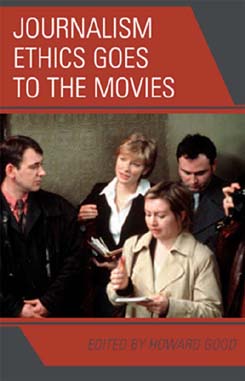
The IJPC Video follows Journalism Ethics Goes to the Movies chapter by chapter. The book’s 12 chapters explore issues that should concern anyone who aspires to a career in journalism, works in journalism or relies on journalism for daily information. The contributors do their exploring at the movies where sportswriters, war correspondents, investigative reporters, crime reporters, spin-doctors, TV anchors and harried city editors jostle for attention.
This is not your typical textbook. Using popular movies to illustrate the kind of ethical dilemmas journalists encounter on the job is guaranteed to excite the interest and stimulate the thinking of students, teachers and journalists alike.
How far should a reporter go for a story? What’s the role of the press at the scene of an emergency – or murder? Why has journalism suddenly become so vulnerable to plagiarists and fakes? Journalism Ethics Goes to the Movies not only poses these and other urgent questions, but also offers candid answers to them. At a time when journalists, teachers, media experts and the public alike worry that journalism has lost its way, Journalism Ethics Goes to the Movies is available to provide guidance.
Good sums up the appeal of this book to students and teachers alike:
“Once our students move from the classroom into the workplace, will they be able to recognize when an ethical issue confronts them? Once our students move from the classroom into the workplace, will they be able to recognize when an ethical issue confronts them? Will they search out the best principle to apply in the situation? Will they have the courage to actually apply it? Or will they simply adopt, as studies indicate most entry-level employees do, the attitudes and practices of the workplace, whether ethical or not? It’s questions like these that led me to consider new ways to teach journalism ethics. Journalism Ethics Goes to the Movies is the result.
The book is founded on the assumption that stories matter. ‘They can offer us,’ child psychiatrist and author Robert S. Coles pointed out, ‘kinsmen, kinswomen, comrades, advisers – offer us other eyes through which we might see, other ears with which we might make soundings.’ Stories have the power to admonish us, console us, get inside our heads and change us. Without stories, there’d be no testimony or record of ‘how real human beings can live through various crises and trials and remain human.’ Without stories, there’d be no Homer, no Bible, no Shakespeare. What might seem even worse to many, without stories, there’d be no movies.
Movies provide the best case studies. They're able to tell detailed stories of journalists who run up against ethical dilemmas – and to do it with popular stars like Cate Blanchett and George Clooney in the lead roles.
But if movies are a source of ethics, it’s not because they express a fully worked-out moral philosophy. Journalism movies tend to be much better at starting a dialog about ethics than finishing it. This isn’t necessarily a bad thing. As Leigh Hafrey, who uses novels and movies to teach business ethics at MIT, said, ‘. . . we can fill in the gaps in our knowledge of the events, our vision of the characters, our assessment of the action, with details drawn from our experience and inclinations.’ In the process – and here’s where student benefit greatly – we gain practice and confidence in answering ethical questions for ourselves.”
The video is for personal use only and is available only to IJPC Associates. It is not available anywhere else.
TABLE OF CONTENTS
Responsible Journalistic Inquiry
The Paper
Fabrication in Journalism
Shattered Glass
Political Manipulation of the Media
Wag the Dog
What Is Good Work?
Absence of Malice
Deception and Undercover Journalism
Mr. Deeds Goes to Town
Mr. Deeds
Covering Sports
The Pride of the Yankees
Eight Men Out
When Journalists Are First Responders
Die Hard
Style Over Substance
Broadcast News
Ethics in Black and White
goodnight, and good luck.
Crime Reporting
Veronica Guerin
The Utopian Nature of Journalistic Truth
The Year of Living Dangerously
Journalism and the Victims of War
Welcome to Sarajevo